Dig
Mark rock and your imps go to work. Gold seams pay for everything that follows, so where you dig first decides how fast the whole dungeon grows.
Browser · 3D · in development
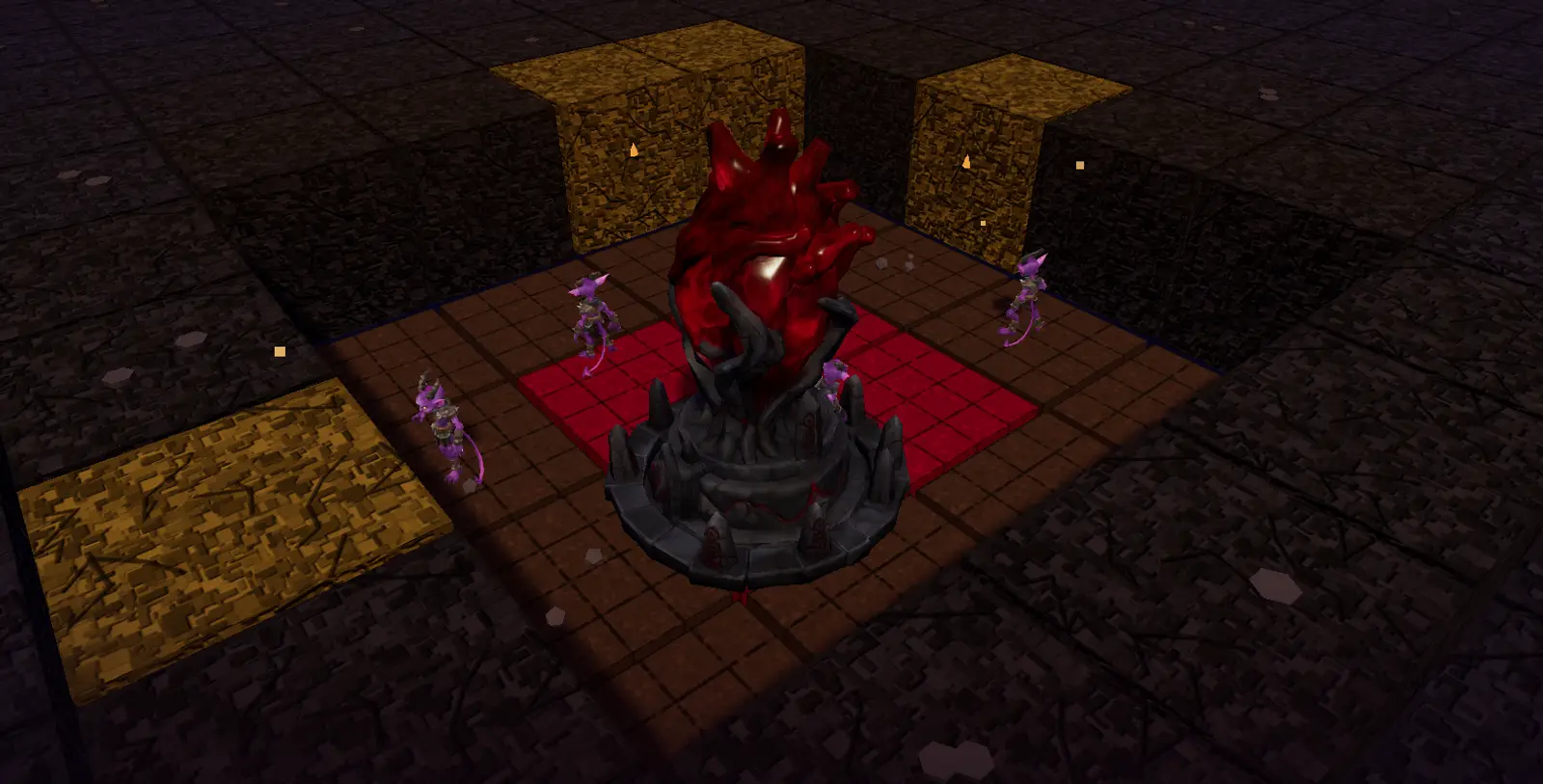
You are the thing under the mountain. Carve tunnels out of solid rock, raise the rooms that keep your dungeon alive, and put every imp and warrior you own between the monsters and the Dungeon Heart.
The loop
Every dungeon starts as one lit room in a mountain of rock. What it becomes is entirely a question of what you dug first.
Mark rock and your imps go to work. Gold seams pay for everything that follows, so where you dig first decides how fast the whole dungeon grows.
Claimed floor becomes rooms. Rooms are not decoration — each one changes a number you are about to need, and adjacent tiles of the same room reinforce each other.
Waves arrive on a timer, and every fifth one brings something considerably worse. Your warriors fight back, your imps die if you forget about them, and the Heart does not regenerate.
Seven rooms
There is no filler here. Each room type does one specific thing, and building the wrong one early is a real setback rather than a cosmetic mistake.
Stores gold. Without it, everything your imps mine has nowhere to go.
+2 to your maximum imp count per tile. More hands, more rock cleared.
New imps arrive faster, so losses during a wave hurt less.
+0.6 mana per second per tile — the resource everything advanced runs on.
+1 warrior training slot. Turning gold into soldiers takes space.
Rally point and warrior training. You need at least one, and you will want it early.
+25% imp dig speed per tile. Pays for itself in rock, not in gold.
Rooms level up, and neighbouring tiles of the same type raise the multiplier together.
What makes it a game
A rare unit that earns XP and levels through a run, and lands a cleave attack no warrior has. Losing one is a different kind of loss than losing a recruit.
Warriors rank up from kills — Recruit, Veteran, Elite — on top of whatever your barracks level gave them at hire. The room sets the floor, the fighting sets the rest.
Grunts give way to faster Stalkers and Runners, then ranged Slingers, door-breaking Sappers, imp-hunting Thieves and Brutes that soak everything you throw at them. Boss waves land on a fixed interval, escorted and scaled the same way a normal wave would be.
Imps and warriors draw wages on a timer. Miss one because the treasury is empty and somebody walks out of your dungeon.
Each run has a stated goal and a win condition, not just an indefinite survival timer that ends when you get bored.
The mana your libraries generate is what you cast with — direct interventions from your own hand, when warriors and walls are not going to be enough on their own.
Lifetime stats and achievements persist between runs, so a disastrous game still moves something forward.
Straight from the game
These are not renders or marketing shots — real glTF exports, rendered with the same lighting rig and the same renderer the game uses, loaded on demand. Drag to rotate. Every model here except Overlord's Hand and the Command Rune is the exact one running in your session mid-game — those two tools stay 2D cursor icons in the game itself by design, and are shown here as art only.
The viewer only downloads once you scroll to it, and the page works perfectly well if it never loads at all.
An interactive 3D model of the imp loads here. It needs WebGL — if your browser or connection says no, you are not missing any information, only the toy.
It runs in the tab you already have open. Nothing to install, nothing to sign up for.
Enter the dungeon (opens in a new tab)