Treasury
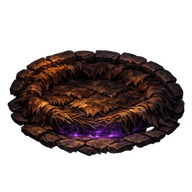
Stores gold and raises the cap on how much you can hold. Gold above the cap is simply lost. You do not need one to mine — imps bank at the Heart too.
The game
ImpKeep is a dungeon-builder in the Dungeon Keeper tradition: you never control a hero directly, you shape the place they have to walk into. Here is the whole thing, without the marketing voice.
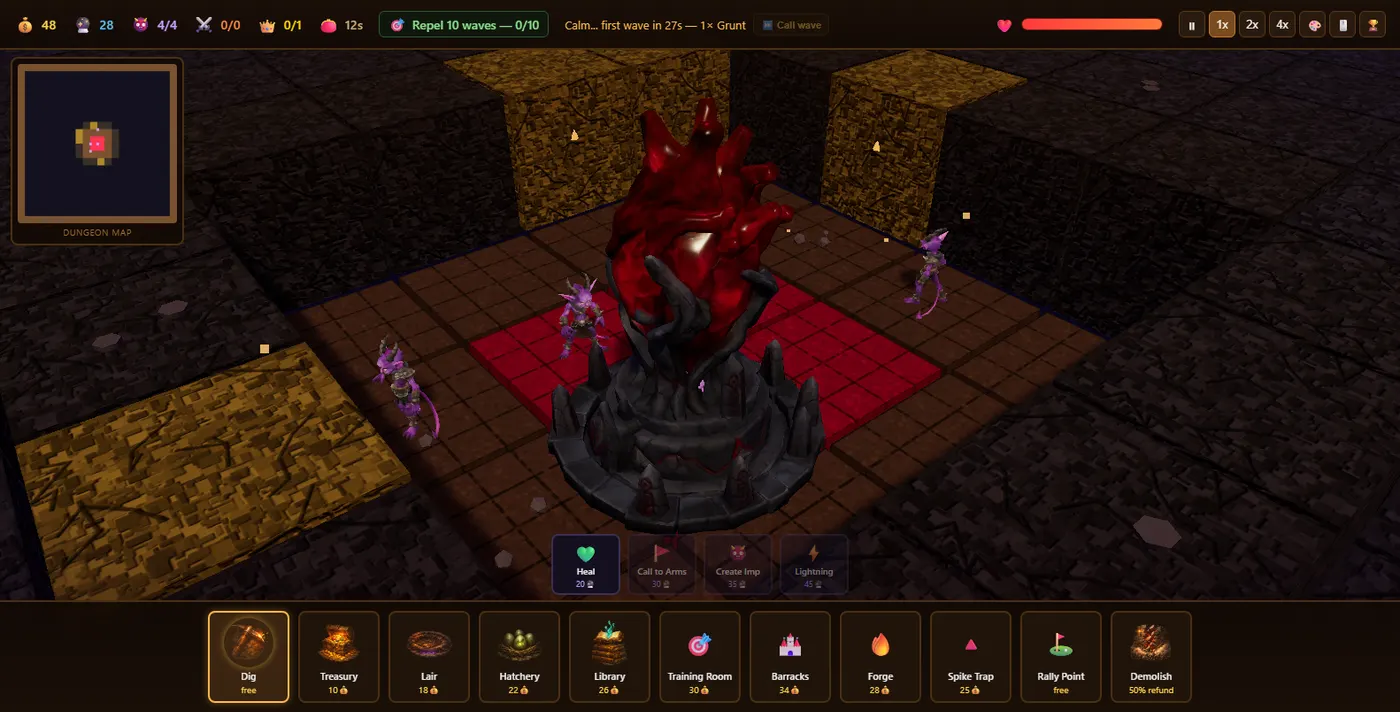
The map starts as solid rock with one lit room in it. You mark tiles to dig; imps walk over and clear them. Cleared rock becomes floor you can claim and build on, and some of it contains gold seams — which is nearly all of your income until your warriors start killing things.
That makes the first two minutes genuinely a decision rather than a formality. Dig toward gold and you can afford rooms early but your dungeon sprawls into open corridors. Dig compactly and you stay defensible but broke.
The monsters cannot reach you until you dig your way to them. Waves spawn on the open ring around the edge of the map, and at the start no dug floor connects that ring to the Heart — a monster never tunnels, so with the rock still solid it just wanders the perimeter. Every corridor a wave walks down is one you opened yourself, usually while chasing a gold seam. And you cannot simply refuse: a run is won by killing all ten waves, not by outlasting them, so a dungeon nothing can enter is not a fortress, it is a run that never ends. Where you break through is the real decision — not whether.
Imps are not invincible. They are workers with hit points, and monsters will target them. An imp economy you never look at is an imp economy that quietly dies during wave four.
Rooms are built on claimed floor and cost gold. Each one does exactly one thing, and tiles of the same room type that sit next to each other reinforce one another — a compact block beats the same number of tiles scattered around, by up to 40% once the block reaches six tiles.
Touching tiles of one type are also treated as a single chamber. Click any tile of it and the panel talks about the whole room rather than that one square: how big it is, and how many of your own creatures are standing in it at that moment — a Lair nobody sleeps in and a Training Room nobody trains in look identical from the outside. Chambers of two different types that share a wall each get a further flat bonus: a Forge next to a Barracks, a Lair next to a Hatchery, a Library next to a Training Room. Where you put things is a decision, not decoration.
Rooms upgrade twice, for gold. The second upgrade is the one that costs more than money — it is permanent and it is a fork. A Treasury becomes either a Vault (more storage) or a Coffer (more income), and every one of the seven has its own pair to choose between.
Stores gold and raises the cap on how much you can hold. Gold above the cap is simply lost. You do not need one to mine — imps bank at the Heart too.
+2 maximum imps per tile. Wounded imps come here to recover. The only room that does either — the cap is 4 without one.
Replacement imps arrive faster. It does not raise the imp cap, so at the cap it changes nothing — and each replacement it hurries along still costs 18 gold.
+0.6 mana per second per tile.
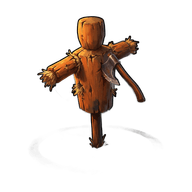
+1 warrior training slot — the only source of them. Slots are not warriors, though: hiring needs a Barracks. Idle warriors walk here and train.
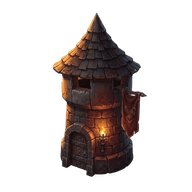
Where warriors and heroes are hired, and its level sets the stats they arrive with. Grants no slots at all, so without a Training Room it hires nobody.
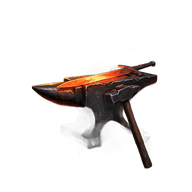
+25% imp dig speed per tile. It multiplies the dig rate and nothing else, so it is worth nothing until you have imps and rock marked for them.
A warrior takes two rooms, not one: a Barracks and a Training Room. The Training Room is the only thing that grants warrior slots and the Barracks is the only place hiring happens, so either one on its own produces exactly zero warriors — a Barracks with no slots to fill, or a slot with nowhere to hire from. All in, your first warrior costs 89 gold and 12 mana: 30 for the Training Room, 34 for the Barracks, and 25 gold plus 12 mana for the warrior himself, out of the 120 gold and 20 mana a Normal run starts with. Once both rooms stand the dungeon hires for you, one warrior every 8 seconds at that same price, up to the slot cap.
It is the sharpest example of a general rule: the game charges you when you click and only afterwards shows you what the room needed. The guide's room table lists all seven rooms with their preconditions next to their effects.
Imps dig, claim floor and carry gold. They are your economy and they are fragile.
An imp that drops below 45% health abandons its job and runs for a Lair, where it heals at 3 hp a second until it is back to 90% and then goes back to work. Without a Lair it runs to the Heart instead — safe, but there is nothing there to heal it, so it stays wounded for the rest of the run and panics again the next time it takes a hit. That is the practical reason to build a Lair beyond the imp cap.
Gold carried by an imp is not lost when the imp is killed. It falls on the floor where it died, and the next imp looking for work will go and fetch it before starting a fresh dig — which turns a dead courier into a decision about whether to send someone back down the tunnel the monsters just came out of.
Warriors are hired from the barracks — into slots that only a Training Room grants, which is why the first one costs 89 gold and 12 mana across two rooms — and fight what comes in. They rank up from kills — Recruit, then Veteran, then Elite — and those multipliers stack on top of whatever your barracks level gave them when they were hired. A veteran from a level-3 barracks is not the same unit as a veteran from a level-1 barracks.
A warrior with nothing to fight and no rally point set walks to a Training Room and trains there, earning the same rank XP a kill would. It is deliberately slow — roughly two and a quarter minutes of uninterrupted training for one promotion, against a wave every 45 to 55 seconds — so it is a use for genuinely quiet time rather than a faster route than fighting. Training also stops at Veteran. Elite has to be earned in combat, because otherwise every warrior would drift to Elite for free given a long enough lull, and "losing a veteran hurts" would stop meaning anything.
Heroes are rare. A hero earns XP and levels during a run, and has a cleave attack that no warrior gets — the point being that a hero is qualitatively different, not just a warrior with bigger numbers.
Monsters arrive on a timer you can also trigger early if you would rather fight on your own schedule. They spawn on the open ring at the edge of the map and head for the Dungeon Heart along your own dug tunnels — anything alive they pass close to is a detour they will take. More archetypes rotate in as the run goes on:
A boss-only Warlord archetype only ever appears in the dedicated boss slot, starting from wave ten.
Every fifth wave is a boss wave: a heavily scaled monster with an escort built the same way a normal wave would be. Wave size is capped at ten, so late waves get harder by composition rather than by throwing twenty bodies at you at once.
The wave straight after a boss is deliberately a soft one — the monsters in it hit and survive noticeably less than the curve says they should. Without that, the hardest ordinary wave so far always arrived while you were still rebuilding from the boss, so a run was usually lost one wave before anything looked wrong. The boss wave itself is scaled slightly up in return; the breather is a shaped curve, not a discount.
A run has a stated objective rather than running until you get bored: hold out until ten waves have been repelled. You pick a difficulty before you start — Easy, Normal or Hard — and it moves your starting gold and mana, the Heart's health, the gap between waves, and how tough monsters are and how hard they hit. It is the same map and the same rules either way, not a separate mode.
Every 45 seconds, each imp and each warrior draws 3 gold in wages from the treasury. If the gold is not there, nothing is taken — you keep whatever you had saved — and instead one random unit that has not ranked up yet walks out of the dungeon, an imp or a warrior, whichever the draw lands on. It is the mechanic that stops "build everything, worry later" from being a viable plan, and it is deliberately a nudge rather than a spiral: confiscating the savings as well used to make an underpaid dungeon impossible to climb out of.
A ranked-up unit never deserts, so pushing a unit past its first rank — by kills, by digging, or by parking an idle warrior in a Training Room — is also insurance against a lean payday. A garrison of veterans that cannot be paid grumbles and stays put.
The rules that bite hardest are the invisible ones. Gold over the cap is silently discarded, a payday you cannot cover costs you a unit, a wounded imp with no Lair never heals. So the HUD carries a one-line advisor that says the single most useful thing about the situation you are actually in — the most urgent one only, and nothing at all when you are doing fine.
Gold is not the only resource. Mana trickles in on its own and Libraries are what make it flow at a useful rate. Mana is what the overlord personally spends — on hiring warriors and heroes out of the barracks, and on five spells you aim by clicking a tile:
Each spell has its own cooldown as well as its price. Mana on its own only limits how many casts you can afford, which meant that with a full mana bar the answer to every emergency was to cast the strongest spell repeatedly; a cooldown limits when. Create Imp is the exception with no cooldown at all — it is economy, not a panic button.
You can also reach into the dungeon directly, without spending anything. Slapping one of your own units costs it 8 health and makes it dig or fight 50% faster for six seconds — never fatal, it stops at 1 health, because a unit you accidentally killed with a click would read as a broken interface rather than a trade-off. The Hand tool picks a unit up and drops it somewhere else, which is how you get a warrior across the map faster than it will walk. And a spike trap (25 gold) sits on a floor tile until the first monster steps on it, deals 40 damage and breaks. It is single-use and there is no way to get the gold back: unlike a room, a trap you tear down again refunds nothing at all, so moving one costs the full 25 a second time.
The other thing you can put on a floor tile is a wooden door (40 gold). Your own units walk through it as if it were not there; monsters cannot, and have to stop and bash through its 120 health instead. So a door is not a wall, it is a toll the attacker pays in time — and to keep it that way, the game refuses to place one anywhere it would seal off the only way through. A dungeon nothing can reach is not a defence, it is a run that never ends. Doors refund nothing either, on the same terms as the trap: relocating a chokepoint is 40 gold every time.
ImpKeep borrows the framing — you are the thing under the mountain, not a hero walking through it — but it is not a clone, and a few differences are deliberate enough to call out for anyone coming from the 1997 original.
| In classic Dungeon Keeper | In ImpKeep |
|---|---|
| "Heroes" are the enemy — knights, wizards and dwarves invading your dungeon. | A hero is a rare unit you hire and level up yourself. The invaders are monsters, not heroes; the word means the opposite thing on purpose. |
| Dungeons run to multiple vertical floors you dig down into. | One map per run. Progression is a campaign of sequential missions, not depth — see below. |
| Underpaid creatures can revolt or abandon the dungeon in a cascading mutiny. | A missed payday costs exactly one random Recruit-rank unit — a penalty for neglect, not a disaster you may not recover from. |
| Full 3D dungeon on isometric tiles, installed client, mouse-driven "Hand of Evil". | Runs in a browser tab: nothing to install, and no account needed to play. Signing in with Google is optional and buys exactly one thing — the same progress on a second device. Same tile-based dungeon, rendered in real Three.js rather than pre-rendered sprites. |
| A large roster of creature types, each recruited and managed individually. | Two core troop types — imps and warriors — plus the rare hero, deliberately narrower so each one carries more weight. |
The game is in active development. A campaign of sequential missions is the current direction for progression: today there is one map with one objective, and the campaign is the thing that turns a scored run into something you come back to.
Two things that used to sit in this paragraph as plans have since shipped. Touch works — one finger rotates or taps, two fingers pan and pinch to zoom — so the game is playable on a tablet rather than only claiming to run in any browser. And the leaderboard is live, ranked per difficulty — it appears on the home page once a run has been submitted and the server is reachable. The hand-made 3D models have grown too, since this section first shipped with just the Dungeon Heart and the imp: every room, every monster, the warrior and hero, the doors, the trap, the torch and rally flag all have a sculpted model now, in place of the procedural geometry that used to stand in for them. Still genuinely ahead: the campaign.
What survives a run has grown too, and it now has a page of its own: your account page lists what is stored against your player — purchases, achievements and lifetime stats, your daily-reward streak, your leaderboard placings, and the bug reports you have sent. Nothing there needs a sign-in to exist; the player behind it is an anonymous ID your browser generated.
Straight from the game
The imp and the Dungeon Heart described above, in the same glTF model, the same lighting rig and the same renderer the game uses on /play/ — loaded on demand. Drag to rotate it.
The viewer only downloads once you scroll to it, and the page works perfectly well if it never loads at all.
An interactive 3D model of the imp loads here. It needs WebGL — if your browser or connection says no, you are not missing any information, only the toy.
It opens in this tab. Nothing to install.
Enter the dungeon (opens in a new tab)